Measuring Marketing ROI: A Practical Guide to Proving Your Value
Measuring Marketing ROI: A Practical Guide to Proving Your Value

In today’s data-driven world, measuring marketing return on investment (ROI) isn’t just a task—it’s how you prove your value. It’s the language that translates your hard work into business growth, justifying budgets and shaping future strategies. Mastering ROI is about showing, with clear numbers, that marketing is a powerful revenue driver, not just a cost center. While the formula seems simple, the real skill lies in accurately defining what you invested and what you truly earned.
Why is Last-Click Attribution Outdated?

For years, marketers credited the very last ad a customer clicked before buying. This “last-click” model is dangerously simple in today’s world. Think about it: a customer might see your ad on Instagram, read a blog post a week later, and finally click a Google ad to purchase. Last-click gives 100% of the credit to the Google ad, ignoring the crucial first steps that built awareness and trust. This flawed view leads to poor budget decisions, as it undervalues the channels that introduce and nurture your future customers.
The solution is multi-touch attribution, a model that distributes credit across the many touchpoints in a customer’s journey. Adopting this approach is a strategic shift towards understanding the complete story of how customers find you. It encourages collaboration between your content, social, and ad teams, as everyone can see their combined impact. Common models include Linear (giving equal credit to all touchpoints) and Time-Decay (giving more credit to touchpoints closer to the sale).
Which KPIs Should You Track for Your Goals?

A common mistake in measuring ROI is using the wrong metrics for the job. You can’t judge a campaign designed for brand awareness by its direct sales figures alone. Every campaign has a primary goal, and that goal determines which key performance indicators (KPIs) matter most. Structuring your measurement this way provides a clear view of performance at each stage of the marketing funnel.
For Awareness Campaigns, your goal is to capture attention. Success is measured by how many people you reach. Your key KPIs are impressions, reach, share of voice (SOV), and increases in branded search volume. Social media engagement and website traffic are also great indicators that you’re successfully capturing interest at the top of the funnel.
For Conversion Campaigns, your goal is to drive action. The KPIs here must be tied directly to efficiency and revenue. The most important metrics are conversion rate, customer acquisition cost (CAC), return on ad spend (ROAS), and average order value (AOV). Analyzing these financial metrics gives you a clear picture of a campaign’s direct impact on your bottom line.
How Can You Measure Offline Marketing’s Impact?
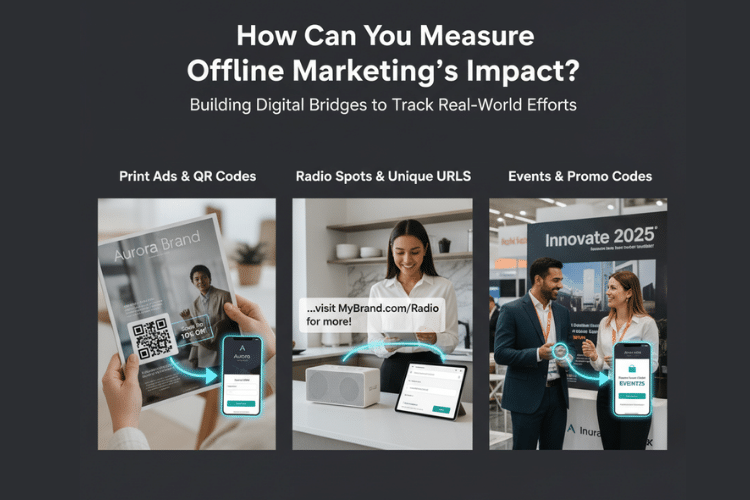
Attributing ROI to offline channels like print ads, radio spots, or events is a classic marketing challenge. Without built-in tracking, how do you know if your billboard ad led to a website sale? The key is to create a clear, measurable digital bridge for your offline audience. This transforms offline measurement from a guessing game into a data-driven exercise.
Here are a few practical ways to build that bridge. Use unique QR codes on your print materials that lead to a specific landing page. In a radio ad, mention a memorable and unique URL (like “mybrand.com/radio”). For an event, create an exclusive promo code that can only be redeemed online. These techniques allow you to directly attribute online activity to a specific offline source, giving you clear signals on what’s working in the real world.
What Are the Essential Tools for Tracking ROI?
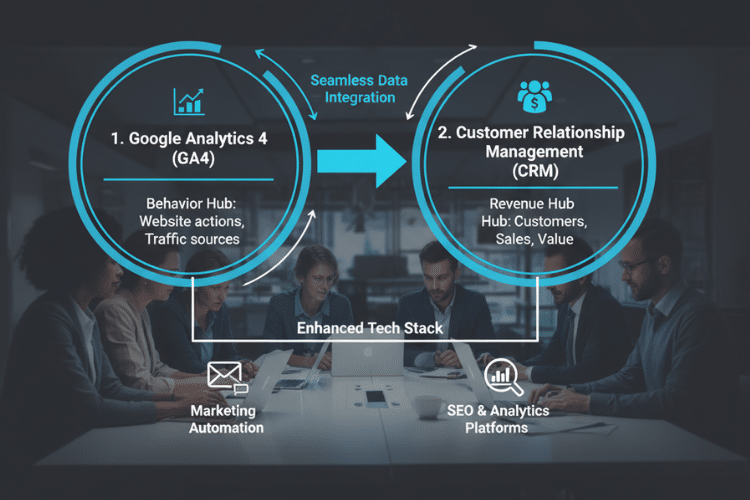
Accurate ROI measurement relies on an integrated tech stack where different platforms work together like a data supply chain. The two most fundamental tools are Google Analytics 4 (GA4) and a Customer Relationship Management (CRM) system. Think of GA4 as the behavior hub—it tells you what people are doing on your website and how they got there. The CRM (like Salesforce or HubSpot) is the revenue hub—it tells you who your customers are and how much they paid.
The real magic happens when you connect them. Integrating GA4 with your CRM allows you to link a specific user’s journey—from their first click on an ad to their final purchase—directly to a sales figure. This connection is the engine that enables true, bottom-line ROI calculation. This core stack can then be enhanced with specialized platforms, such as marketing automation tools or SEO software like SEMrush and Ahrefs, to get an even richer picture.
How to Present Your Marketing ROI and Prove Your Value

The final step is communicating your results to stakeholders. Your goal is to tell a compelling story, not just dump data in a spreadsheet. A strong ROI report translates complex numbers into a clear narrative about business impact. It should be tailored to your audience—executives care about the high-level financial impact, while the sales team might focus more on lead quality.
Always start with an executive summary stating the key findings upfront. Then, present your results using clean, simple charts and graphs to make the information easy to digest. Most importantly, explain the “why” behind the numbers in your analysis and insights section. Conclude with clear, actionable recommendations for future strategy based on what you’ve learned. By consistently linking your marketing efforts to business objectives, you transform your role from a functional manager into a strategic driver of growth.
You Might Also Be Interested In These Articles