A Deep Dive into B2B Marketing: Strategies for High-Value Accounts
A Deep Dive into B2B Marketing: Strategies for High-Value Accounts

Business-to-Business (B2B) marketing operates in a different universe than its Business-to-Consumer (B2C) counterpart. While B2C often focuses on broad appeal and quick conversions, B2B is the art of precision and strategic relationship-building. Success isn’t about casting the widest net possible; it’s about spearfishing for high-value accounts that can transform a business. This requires a deep understanding of complex buying cycles, a commitment to providing substantial value, and a playbook tailored for long-term partnerships. Let’s explore the core strategies that empower B2B marketers to win and retain these crucial accounts.
Key Differences Between B2B and B2C Customer Journeys

The B2B customer journey is fundamentally different from the B2C path to purchase. B2C decisions are often emotional and made by an individual, leading to a short, linear sales cycle. In contrast, B2B decisions are driven by logic, ROI, and efficiency, involving a committee of stakeholders with different priorities. This creates a long and complex journey with multiple touchpoints, requiring extensive research and internal consensus-building. Consequently, B2B marketing isn’t about persuading one person; it’s about equipping an internal champion with the information they need to convince their entire team. The goal is to build a long-term, high-value strategic partnership, not just complete a single transaction.
Account-Based Marketing (ABM) as a Core B2B Strategy
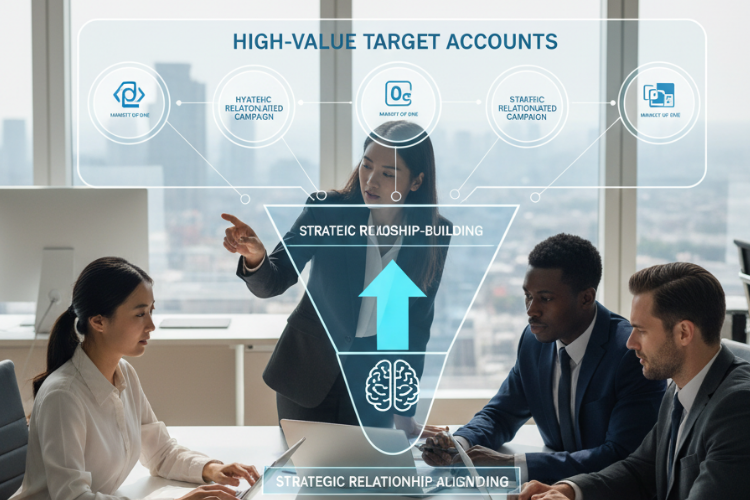
Account-Based Marketing (ABM) is the perfect strategic response to the complex B2B journey. Instead of the traditional funnel that starts wide, ABM inverts it by first identifying a select list of high-value target accounts. Marketing and sales teams then align closely to orchestrate hyper-personalized campaigns for these specific accounts, treating each one as a “market of one”. This approach eliminates wasted resources by focusing exclusively on prospects with the highest revenue potential. Success in ABM is measured not by the volume of leads, but by the depth of engagement and penetration within these key accounts, fostering stronger, more strategic business relationships.
Content Strategies for a B2B Audience: Whitepapers, Webinars, and Industry Reports

In B2B marketing, content serves a critical role in building trust and demonstrating expertise. Unlike B2C content, which often aims to entertain, B2B content must educate and solve complex problems for a professional audience. In-depth formats like whitepapers, webinars, and original industry reports are essential tools in this process. A well-researched whitepaper shows you have a deep understanding of your client’s challenges, while a live webinar offers direct engagement with your experts. These substantial content pieces are not just lead magnets; they are powerful trust signals and sales enablement tools that help buyers justify their decisions internally.
Leveraging LinkedIn for High-Quality B2B Lead Generation
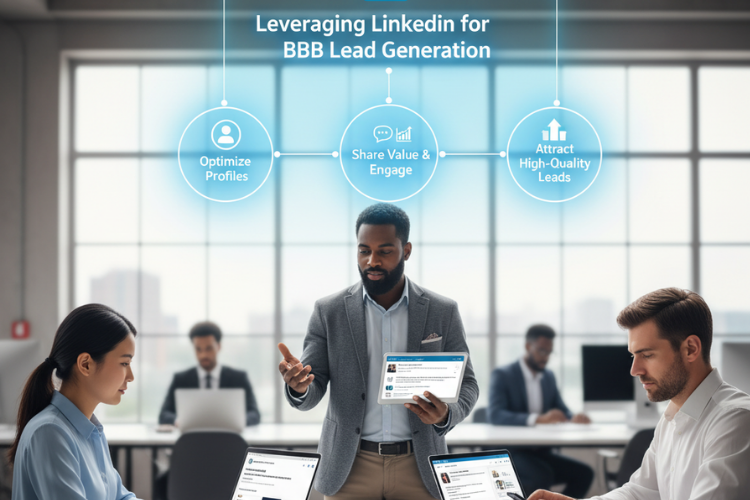
LinkedIn is the definitive digital arena for B2B professionals, making it an indispensable channel for lead generation. The first step is to optimize both your personal profile and company page to act as credibility hubs that clearly state your value proposition. Success on the platform comes from consistently sharing valuable, educational content that positions you as a thought leader, rather than using direct sales pitches. Engage authentically by commenting on posts, participating in industry groups, and starting meaningful conversations. By building a reputation for expertise, you attract high-quality leads organically, as they are a natural byproduct of established authority.
Measuring Success in a Long and Complex B2B Sales Cycle

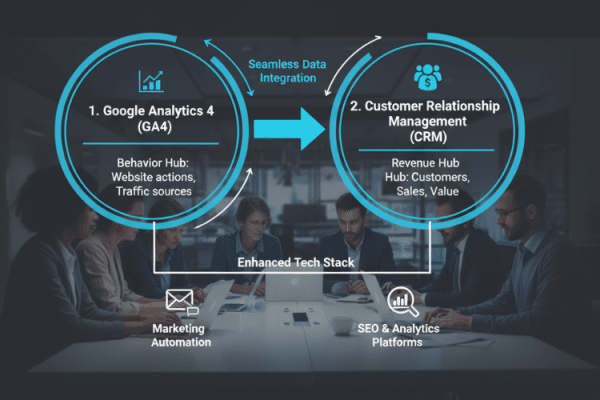
Measuring ROI in B2B marketing is far more nuanced than in B2C due to the long and complex sales cycle. Simple last-touch attribution models are ineffective because they fail to capture the numerous interactions that influence a final decision. Instead, B2B marketers must focus on metrics like pipeline velocity, customer acquisition cost (CAC), and customer lifetime value (CLV). Success requires robust tracking systems, integrating marketing automation with a CRM to monitor the entire journey. Ultimately, B2B measurement is less about proving direct causation and more about telling a data-backed story of influence, showing how marketing activities educate buyers and guide them toward a final decision.
You Might Also Be Interested In These Articles