B2B Customer Journey Mapping: Strategies for Complex Sales Cycles
B2B Customer Journey Mapping: Strategies for Complex Sales Cycles

The world of business-to-business (B2B) sales is a complex ecosystem with its own unique dynamics. Unlike the often quick and emotional decisions of individual consumers (B2C), the B2B customer journey resembles a marathon that involves multiple stakeholders and is based on long-term, logical analysis. Mapping this journey correctly is not just a marketing activity but a critical strategic imperative for winning and retaining high-value accounts. An effective B2B customer journey map allows you to understand your potential customers, offer them solutions tailored to their needs, and ultimately shorten sales cycles to maximize your return on investment (ROI). This guide reveals modern and proven strategies for managing complex B2B sales processes.
Key Differences Between B2B and B2C Customer Journeys
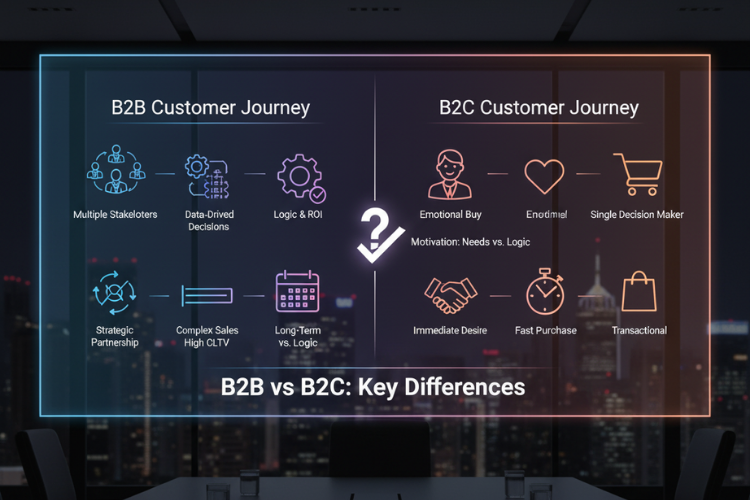
The most fundamental distinction between B2B and B2C customer journeys lies in the motivation for purchasing. While B2C customers are often driven by personal needs, immediate desires, and emotional connections, B2B buyers make decisions based on logic, data, and tangible business objectives like return on investment (ROI). In B2C, the decision-maker is typically a single person, whereas the B2B process involves a buying committee composed of different departments such as finance, IT, and operations, requiring approval from each stakeholder. This causes B2B sales cycles to last for weeks or even months, while B2C transactions can often be completed in minutes. Furthermore, B2B relationships focus on long-term strategic partnerships characterized by a high customer lifetime value (CLV), whereas B2C relationships tend to be more transactional. Therefore, B2B marketing focuses on building trust and authority, while B2C marketing aims to create brand awareness and emotional bonds.
Personalizing the B2B Customer Journey with Account-Based Marketing (ABM)
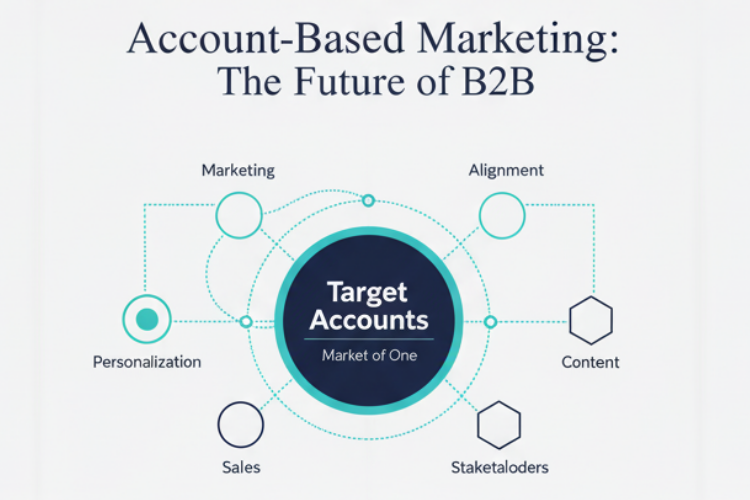
Account-Based Marketing (ABM) is the most effective strategic response to the complexity of the B2B customer journey. Unlike traditional marketing, which aims to cast a wide net to catch as many potential customers as possible, ABM concentrates resources and efforts on a pre-selected set of high-value target accounts. This approach treats each target account as a “market of one,” personalizing marketing messages, content, and campaigns according to that account’s specific needs, pain points, and decision-makers. The success of ABM requires complete alignment between marketing and sales teams; these two teams work together to identify target accounts, map stakeholders, and execute a coordinated communication strategy. As a result, ABM delivers shorter sales cycles, higher conversion rates, increased customer lifetime value, and a clearer return on investment (ROI) on marketing spend.
Value-Driven Content Marketing: The Art of Influencing B2B Decision-Makers

In the B2B world, content is not just a marketing tool; it is the cornerstone of building trust, demonstrating authority, and simplifying complex purchasing decisions. Value-driven content marketing aims to educate potential customers about their industry and the challenges they face, rather than trying to sell a product or service. At the heart of this strategy lies the creation of tailored content for the different stages of the long B2B decision-making process. Educational blog posts and industry reports for the awareness stage, in-depth white papers and webinars for the consideration stage, and case studies and product demos for the decision stage all play a critical role. The most effective B2B content acts as sales enablement material, providing your “champion” within the target account with the data, arguments, and proof they need to convince their own organization.
Generating Qualified B2B Leads with LinkedIn
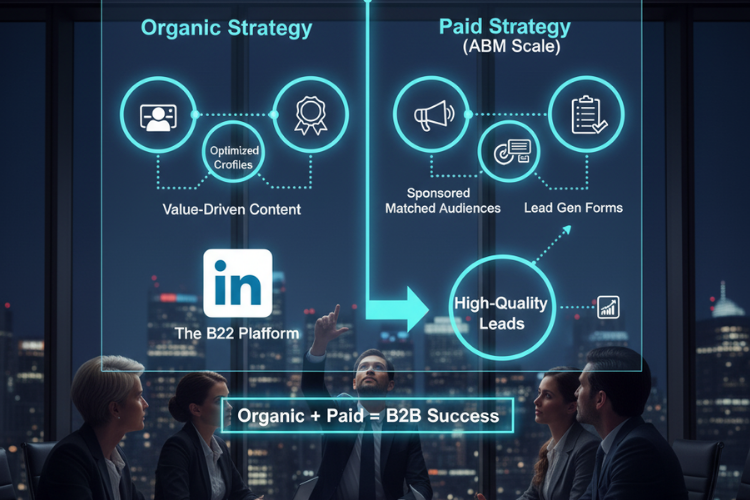
LinkedIn is the dominant platform in its field, used by the vast majority of B2B marketers to generate potential customers. To execute a B2B customer journey strategy, LinkedIn offers unique opportunities with both its organic and paid tools. The foundation of an organic strategy is to optimize the profiles of decision-makers and company pages to be centers of authority; this is achieved through a professional image, value-driven summaries, and regularly shared useful content. To scale an Account-Based Marketing (ABM) strategy, LinkedIn’s paid advertising tools come into play. With “Sponsored Content,” you can deliver your valuable content (white papers, webinars, etc.) directly into your target audience’s feed, and with the “Matched Audiences” feature, you can pinpoint specific individuals from the target account list in your CRM. In particular, LinkedIn “Lead Gen Forms” streamline the conversion process by auto-filling user information, allowing you to efficiently collect high-quality leads.
You Might Also Be Interested In These Articles